Study library
How to use an interlinear Bible: John 1:1 worked example
Learn the difference between a Greek word, lemma, gloss, morphology and Strong’s number through a careful example in John 1:1.
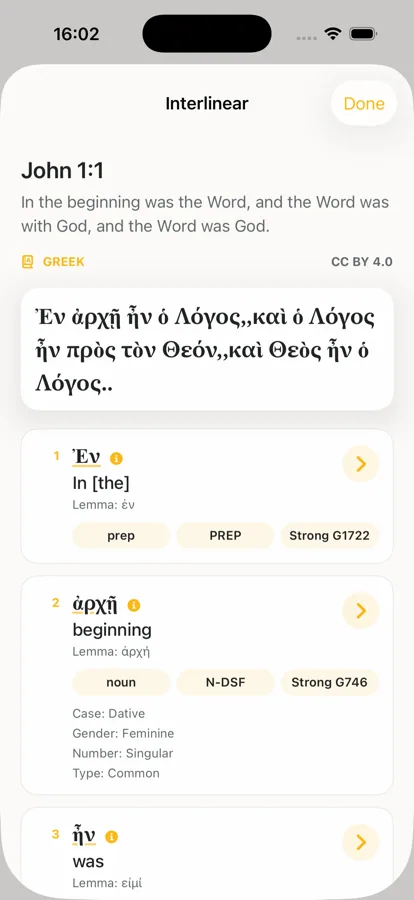
An interlinear Bible aligns an original-language text with translation helps. It can show a word’s form, its dictionary entry, a short gloss and grammar information. It is a starting point for investigation, not a word-for-word code that eliminates interpretation.
The five things to distinguish
| Label | Meaning | What it does not tell you by itself |
|---|---|---|
| Word form | The form printed in this verse | Every use of that form in every setting |
| Lemma | The dictionary headword | The meaning intended in this passage |
| Gloss | A short translation help | A complete definition |
| Strong’s number | An index used to connect lexical entries | A meaning that can be substituted into every verse |
| Morphology | A description of grammatical form | The whole argument of a sentence or paragraph |
A worked example: λόγος in John 1:1
Read John 1:1–18 in a translation first. Then inspect λόγος, commonly rendered “Word” in John 1:1. Its lemma is λόγος, and the Strong’s index is G3056. In this occurrence, the grammatical form is nominative masculine singular.
That information helps identify the word. It does not mean that every sense listed for G3056 belongs in John 1:1. A dictionary may list several senses across different passages; the immediate sentence and the wider prologue constrain which interpretation fits here.
Follow a repeatable workflow
- Write your question before opening the lexicon. For example: “How does John develop the description of the Word within the prologue?”
- Identify the word form, lemma and index. Check that you selected the intended word.
- Read the lexical entry as a set of possible uses, not a list of meanings to combine.
- Compare the surrounding passage, especially John 1:1–5 and 1:14–18.
- Check an established study resource and record where interpretations differ.
- Return to the passage and state what you learned, what remains uncertain and which sources support your conclusion.
Three mistakes to avoid
Adding all dictionary meanings together. A word’s range across many contexts is not its meaning in every sentence.
Treating an index number as an argument. A Strong’s number makes lookup easier. It does not establish doctrine or resolve syntax.
Using word history instead of current context. The origin or parts of a word do not necessarily determine how an author uses it. Read the sentence and the author’s argument.
Try it yourself
Use STEP Bible alongside John 1:1–18. Write three separate lines: lexical information, what the passage says, and your interpretation. Keeping these distinct makes an original-language study easier to review with a teacher.
In My Bible Companion, select a single verse and open the interlinear or lexicon tools. Keep the surrounding chapter nearby. See the chapter-study example for a method that starts with the passage before secondary tools.
Sources
- John 1:1–18
- STEP Bible: original-language study
- G3056: λόγος lexical entry
- My Bible Companion: official App Store listing
Prepared with AI assistance from the app's study material and the sources below. Check interpretations against the passage and trusted teaching.